Tag

Development

Long-form notes and shorter moments filed under “Development”.

Binyang

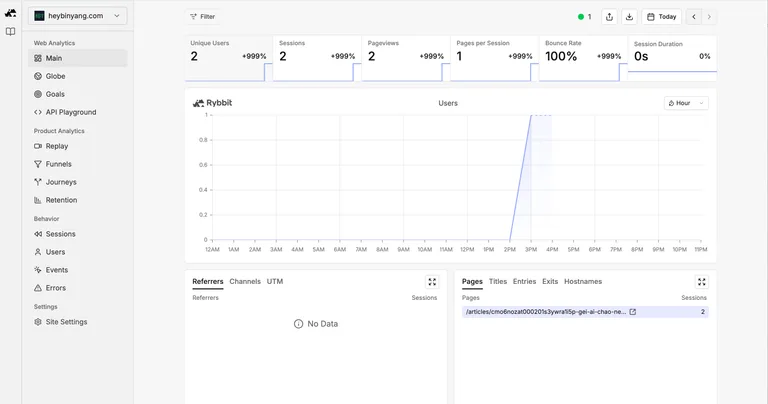
Rybbit - an open-source and privacy-focused Google Analytics alternative, with a more intuitive and easy-to-use experience, fully 10x better. Let Codex help me self-host this service on my RN VPS, and also integrate it with this current website. This kind of workload was unimaginable before Codex. It's not that it's difficult or complex, it's that installing software and configuring the environment is too troublesome. Now it's automatically done in a few minutes. I just help out by adding one domain A record.

View on moments page

Binyang

fumadocs.dev is a beautiful and flexible documentation framework for any React.js project.

View on moments page

Binyang

A few days ago, I tried translating a PDF ebook using Ollama with a local Qwen 3.5:4b model. Translation speed wasn't an issue, but the final layout turned out poorly. My workflow was to first convert the PDF to Markdown, translate it, and then generate a new PDF. However, the bilingual vertical layout (Chinese-English) in the resulting PDF was hard to read and very uncomfortable. I looked into this problem and realized PDF text layout is indeed difficult to handle. Different books have different content and require different presentation styles. Optimizing and adjusting the layout for each book costs too much effort. Finally, I found that HTML is the most suitable choice—styling is easy and results in a clean layout, and my goal is simply to translate and read comfortably. With this approach, I'll continue to improve it later and use it to help me read English books.

View on moments page

Binyang

Today I saw Vercel's Lab open-source portless, which allows accessing local projects without using port numbers and eliminates the need to worry about port conflicts. - "dev": "next dev" # http://localhost:3000 + "dev": "portless myapp next dev" # https://myapp.localhost

View on moments page

Binyang

Most AI coding tools now support multi-agent workflows, meaning you can build different features in parallel. But in practice—even on small personal projects—I haven’t found this approach particularly helpful. The codebase grows rapidly, and beyond potential conflicts, the biggest downside is that it just feels exhausting. With a more traditional way of coding, moving from thinking to implementation, it’s much easier to get into a flow state. Ironically, actually writing code is what helps me relax. For a simple feature, the real challenge is making it intuitive and well-designed. That’s where meaningful collaboration with AI should happen. Your thinking process needs to work alongside AI to produce code that’s actually useful and sustainable over time.

View on moments page

Binyang

When building a product, don’t fall into the trap of complex solutions at the beginning, even if you are a very experienced developer. The first thing to consider is your ability to acquire and serve 0–100 and 0–1000 users. The technical solution should be as simple as possible, so that it helps with fast release, fast validation, and quickly moving into the development of core features. AI capabilities have made the development of many advanced features extremely easy, but do you really need them? Do users really care? If you cannot make good insights and judgments, AI will instead trap you in meaningless consumption, such as time and tokens.

View on moments page

Binyang

Web is still the most worthwhile platform and distribution channel to develop for. On iOS, when you share a website to the home screen, you will see an app launch icon. After tapping the icon to open it, you won’t see the browser address bar, and it feels completely like an independent app. Recently, I’ve started to rethink: 1. With AI assistance, the cost and difficulty of developing native apps have been greatly reduced, but the cost of publishing and maintaining on both systems is still high. 2. Is it necessary to develop mini programs? 3. Can it already meet user needs and user experience?

View on moments page

Binyang

Milestone: Added multilingual support for three languages: Simplified Chinese, Traditional Chinese, and English.

View on moments page

Binyang

Design and development principles • Avoid redundancy and keep the implementation simple • Follow the principle of minimal changes to prevent intrusive impact on existing functionality • Maintain system consistency and avoid introducing unnecessary variants and edge-case complexity • Prioritize long-term maintainability over short-term feature delivery • All code and design must undergo line-by-line manual review

View on moments page
Development · Tag · HeyBinyang