Hermes Agent Deep Dive and Comparison with OpenClaw
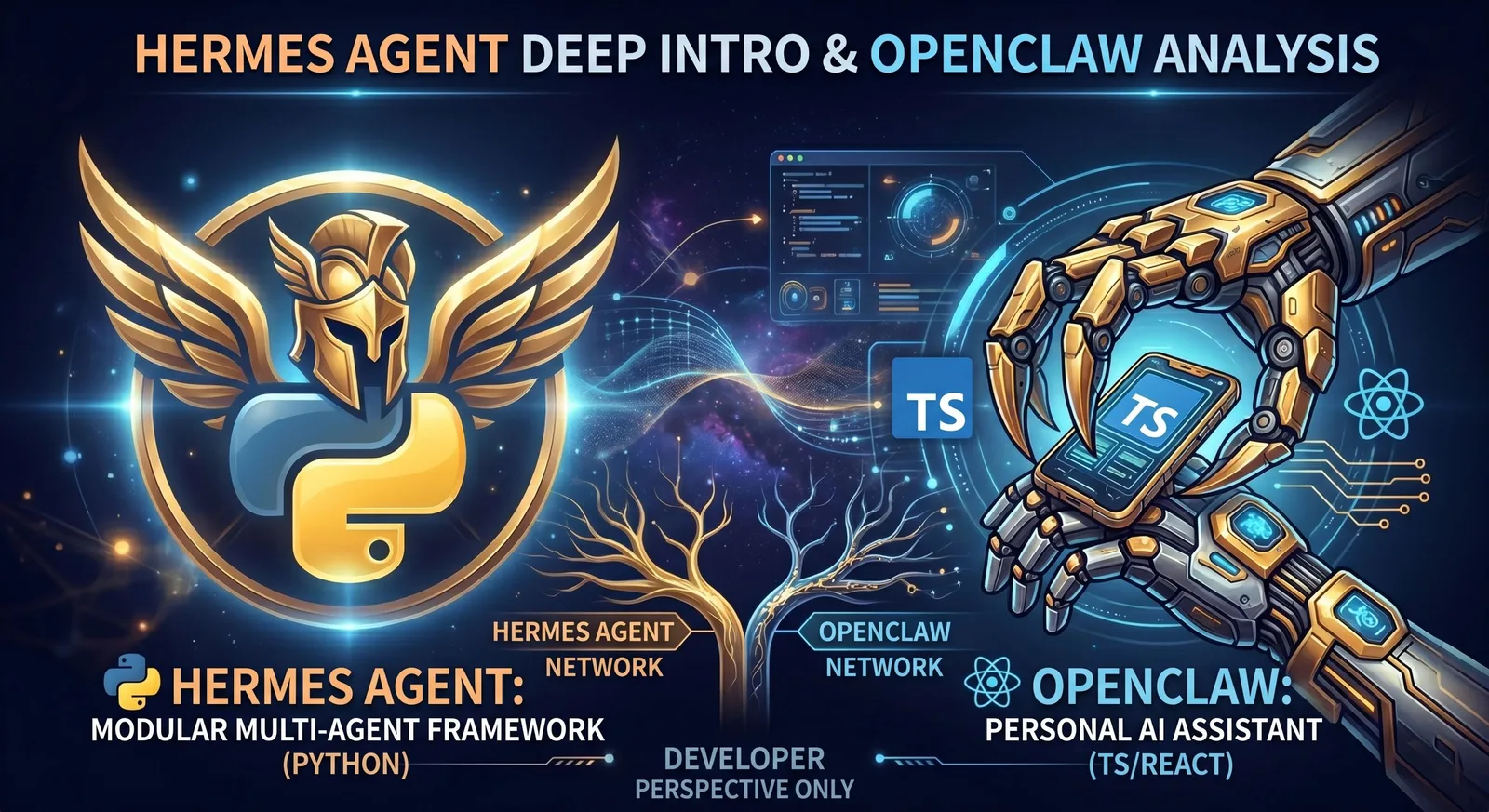
Hermes Agent is a self-evolving AI agent framework open-sourced by Nous Research at the end of February 2026. By early May, it has exceeded 100,000 stars on GitHub, making it one of the fastest-growing open-source projects of 2026. The biggest feature of this lightweight Python-based framework is that it "gets smarter with use" — it automatically learns from each task, creates and improves its own skills, and builds long-term memory.
Core Positioning Differences
Although both Hermes Agent and OpenClaw are AI agent frameworks, they differ fundamentally in design philosophy. Hermes Agent is a single-core agent, like a focused "automated employee" that improves its abilities through continuous learning; OpenClaw, on the other hand, is a full-platform control hub, more like a "scheduling center" that manages multiple AI resources and capabilities, emphasizing multi-agent orchestration and ecosystem integration.
From a tech stack perspective, Hermes Agent is written in Python with clean code structure, and its core logic revolves around run_agent.py, making it easy for beginners to get started; OpenClaw uses TypeScript with a Gateway + orchestration architecture, which is more complex but offers stronger extensibility.
Core Capabilities of Hermes Agent
Self-Evolution Mechanism
The most groundbreaking feature of Hermes Agent is its Closed Learning Loop. When you complete a complex task, the Agent automatically encapsulates the solution into a reusable Skill; if the task execution fails, it automatically generates a Patch to fix it; when the user corrects its behavior, it automatically updates the workflow. Officials define these Skills as "Procedural Memory", meaning that once you teach it something today, you don't need to repeat it tomorrow.
Layered Memory System
Hermes Agent provides a five-layer memory architecture:
Context Window: Records the real-time content of the current conversation
Prompt Memory: Stores core instructions and preferences
Procedural Memory: Automatically generated Skills
Session Search: Historical conversation retrieval based on FTS5 full-text index
User Modeling: Builds user preference models via the Honcho framework
This design allows the Agent to maintain continuity across sessions, truly achieving the effect of "the more you use it, the better it understands you."
Multi-Platform Access
Hermes Agent supports unified access to 14+ platforms, including command-line CLI, Telegram, Discord, Slack, WhatsApp, Signal, Email, Home Assistant, etc. Simply run the hermes gateway command once, and it will serve across all platforms simultaneously — very practical for personal assistants and team collaboration scenarios.
Model & Tool Ecosystem
The framework natively supports 118 built-in tools covering code development (GitHub, Shell, Docker), web retrieval, image generation, text-to-speech, MLOps, and more. More importantly, it fully supports the Model Context Protocol (MCP), allowing access to any MCP Server in the community for unlimited tool expansion.
In terms of model support, Hermes Agent is not tied to any vendor. It supports OpenAI, Anthropic Claude, Google Gemini, OpenRouter (200+ models), GLM, Kimi, MiniMax, and any OpenAI-compatible custom endpoint. Switching models requires only a single hermes model command, without any code modification.
OpenClaw's Unique Advantages
Despite Hermes Agent's rapid rise, OpenClaw, with its 355,000+ GitHub stars and mature enterprise architecture, still holds irreplaceable advantages in certain scenarios.
Enterprise-Grade Architecture
OpenClaw adopts a three-layer decoupled architecture of "Gateway - Node - Channel", natively supporting multi-account, multi-channel, and multi-agent routing. It provides a complete web console, firewall, scheduling system, and permission framework, making it suitable for production environments requiring 7×24 stable operation.
Mature Plugin Ecosystem
OpenClaw has a ClawHub skill marketplace supporting enterprise-level features like multi-directory priority, one-click installation, and security allowlisting. As of early 2026, OpenClaw has over 100 built-in skills, with an extremely large community ecosystem — an advantage that Hermes Agent will find hard to catch up with in the short term.
Rich Built-in Features
OpenClaw comes with built-in browser control, voice interaction (wake word + conversation), visual workspace (Canvas), scheduled tasks, node management, and native mobile apps. These features require extensions in Hermes Agent but are ready out-of-the-box in OpenClaw. As of early May, OpenClaw maintains a release cadence of approximately once every two days, with the latest version being v2026.4.29.
Technical Comparison Details
Skill System
This is the biggest difference between the two. Hermes Agent allows the Agent to create, modify, patch, and delete skills on its own, treating skills as evolving "procedural memory"; OpenClaw emphasizes platform-based skill management, using ClawHub for skill distribution, installation, and version control. The former is better suited for personal deep customization, while the latter is more suitable for team collaboration and knowledge sharing.
Memory & Retrieval
Hermes Agent adopts a native memory design with MEMORY.md + FTS5 full-text index + user profiles, resulting in more stable prompts; OpenClaw provides vector search + hybrid keyword retrieval, supports multi-agent memory sharing/isolation, and uses Markdown + SQLite indexing for systematic management.
Security Comparison
In terms of security, the two show clear differences. As of early May, Hermes Agent has no publicly recorded CVE security vulnerabilities. In contrast, OpenClaw disclosed 9 CVEs within 4 days in March 2026, with the highest CVSS score reaching 9.9 (critical), involving issues like third-party skill data leakage. OpenClaw currently has over 135,000 publicly exposed instances distributed across 82 countries, with a community malicious skill interception rate of approximately 17%.
Token Consumption
A comparative study between Claude Code and OpenClaw shows that OpenClaw has higher token consumption due to multi-model adaptation and structured parameters. Hermes Agent adopts a lightweight design with relatively lower token consumption, making it more economical for long-term personal use.
Deployment Flexibility
Hermes Agent supports 6 terminal execution backends: Local (local), Docker (container isolation), SSH (remote execution), Daytona (cloud-based hibernatable environment), Singularity (HPC/GPU clusters), and Modal (Serverless). This design allows it to run on a $5/month VPS as well as be deployed on enterprise GPU clusters.
OpenClaw primarily focuses on local and cloud deployment, with one-click deployment solutions available on Alibaba Cloud and Tencent Cloud, making it suitable for team users who need stable hosting.
Growth Data Comparison
Hermes Agent Growth Trajectory
Hermes Agent's growth rate is remarkable:
February 25: Official open-source release
March 11: Exceeded 22,000 stars, 242 contributors
April 8: Released v0.8.0, with 6,400 new stars in a single day
April 11: Reached 57,200 stars, 274 contributors, 80+ ecosystem projects
April 17: Surpassed 97,000 stars
May 2: Exceeded 100,000 stars, becoming a top 0.0014% project in GitHub history
The total ecosystem stars have reached over 90,000, with the community developing 80+ ecosystem projects, including 4 community GUIs (supporting desktop, web, and PWA).
OpenClaw Current Data
As of early May, OpenClaw's data shows:
GitHub Stars: 355,000+ (growth over 5 months)
npm Dependencies: 88+ packages directly depend on OpenClaw
Release Frequency: Approximately once every two days
Latest Version: v2026.4.29 (released on April 30, 2026)
Although OpenClaw's absolute star count far exceeds Hermes Agent, the speed at which Hermes Agent reached 100,000 stars in 10 weeks set a historical record for open-source projects.
Choosing the Right Use Case
When to Choose Hermes Agent
Personal Long-Term AI Assistant: You want the Agent to remember your habits and preferences, getting better with use
Lightweight Deployment: Limited budget ($5 VPS), no need for complex multi-agent orchestration
Model Flexibility: You frequently switch between different models and don't want to be locked into a single vendor
Coding & Automation: On OpenRouter's productivity leaderboard, Hermes performs excellently in coding scenarios
Smart Home Integration: Native support for Home Assistant, ideal for home automation scenarios
Security First: Currently no known CVE vulnerabilities
When to Choose OpenClaw
Enterprise Production Environment: Need multi-account, multi-channel, failover, and hot model switching
Team Collaboration: Multiple users sharing, requiring permission management and session persistence
Mature Plugin Needs: Rely on the existing vast plugin ecosystem for rapid capability building
Social Media & Operations: Group control, multi-platform automated operations, scheduled tasks
Visual Management: Need graphical interfaces like web console, Canvas
Research Automation: Mature applications in academic search, LaTeX compilation, and other research tool markets
Quick Start
Installing Hermes Agent is very simple — just one command:
curl -fsSL https://raw.githubusercontent.com/NousResearch/hermes-agent/main/scripts/install.sh | bashAfter installation, run the configuration wizard:
hermes setup  # Configure models and platforms
hermes        # Start interactive CLI
For developers who need to access multiple mainstream models, you can choose "Custom OpenAI-compatible endpoint" during setup, fill in a compatible API endpoint, and configure once to call all major models such as GPT-5, Claude Opus 4.6, Gemini 3 Pro, etc.
Community Trends
As of early May 2026, Hermes Agent surpassed 100,000 GitHub stars in just 10 weeks since its release, setting a historical record for open-source project growth speed. Although OpenClaw maintains a total star advantage at 355,000, it faces challenges in security and update frequency. The community generally believes that 2026 will be a "two titans battling" landscape between Hermes Agent and OpenClaw.
In a nutshell: If you want a smart assistant that gets better on its own and is more secure, choose Hermes; if you need a mature enterprise scheduling platform with multi-account and multi-channel capabilities, choose OpenClaw.
Follow on Google
Add HeyBinyang as a preferred source on Google
If you'd like to keep finding my updates through Google, you can mark this site as a preferred source and make it easier to spot in relevant reading flows.
SHARE
Share
Share this article.